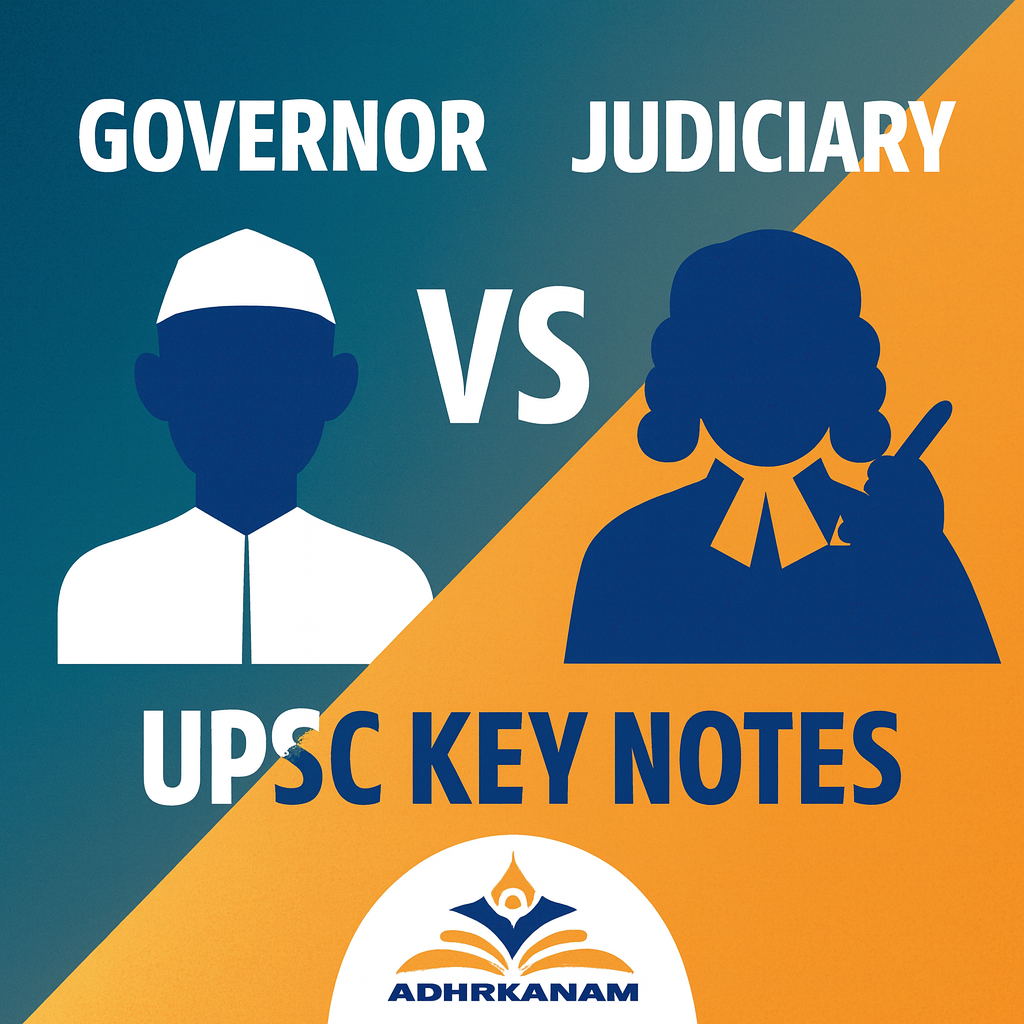
A five-judge Constitution Bench of the Supreme Court answered the 16th Presidential Reference. It ruled that the judiciary cannot impose timelines or assume “deemed consent” for Bills pending with the President or Governors.
|
Governor’s Discretion vs Judicial Boundaries: A Constitutional Breakdown UPSC|CSE SYLLABUS Preliminary: Constitution, Political System, Panchayati Raj, Public Policy, Rights Issues, etc. Mains: (GS-II): Cooperative federalism, constitutional morality, checks and balances. PCS-J | LAW: Case law analysis, constitutional interpretation, evolving judicial doctrines. CONTEMPORARY RELEVANCE: Strengthening democratic accountability, reducing friction between Raj Bhavan and Vidhan Sabha.
|
Governor’s Discretion vs Judicial Boundaries: A Constitutional Breakdown
. 
Why in News?
- A five-judge Constitution Bench of the Supreme Court answered the 16th Presidential Reference.
- It ruled that the judiciary cannot impose timelines or assume “deemed consent” for Bills pending with the President or Governors.
- The Court emphasized the doctrine of separation of powers but warned against prolonged and evasive inaction by constitutional heads.
More About the News
Issue: Governors and the President often delay assent to Bills passed by State legislatures.
Earlier SC ruling (April 2025): Had prescribed timelines for assent decisions.
Presidential Reference (Article 143): Honourable President Mrs Droupati Murmu sought clarity on whether courts can enforce timelines or deemed assent.
SC’s Answer (Nov 2025):
-
- No judicially fixed timelines.
- No deemed assent.
- But prolonged inaction is unconstitutional.
Timeline
- April 2025: SC directed Governors to act within timelines on Bills.
- Mid-2025: Concerns raised about judicial overreach → Presidential Reference filed.
- Nov 2025: Constitution Bench (CJI B.R. Gavai, Justice Surya Kant, Justice Vikram Nath, Justice P.S. Narasimha, Justice A.S. Chandurkar) delivered ruling.
In a Nutshell
- Judiciary cannot tie hands of Governors/President with rigid deadlines.
- Deemed assent is unconstitutional.
- Governors/President must act reasonably — prolonged inaction is not allowed.
- Reinforces separation of powers + cooperative federalism.
Way Forward
- Legislative clarity: Parliament may consider codifying reasonable timelines for assent.
- Accountability: Governors/President expected to act in good faith, not stall democracy.
- Judicial restraint: Courts will intervene only against abuse of power, not to dictate executive timelines.
- Federal harmony: Encourages constructive dialogue between State legislatures and constitutional heads.
Constitutional power for Governor:
- Articles 153–162: Establish office and executive powers.
- Article 163: Governor acts on aid and advice of Council of Ministers, except in matters requiring discretion.
- Article 200: Assent to Bills – options include assent, reservation for President, or return for reconsideration.
- Article 356: Governor’s report as basis for President’s Rule.
- Discretionary Powers: Appointment of CM, dissolution of Assembly, reservation of Bills, reporting constitutional breakdown.
Judicial Boundaries and Key Verdicts
- Shamsher Singh v. State of Punjab (1974): Governor is a constitutional head and discretion is limited.
- SR Bommai v. Union of India (1994): Judicial review of Governor’s report under Article 356.
- Nabam Rebia v. Deputy Speaker (2016): Governor cannot interfere in legislative proceedings.
- Recent SC Presidential Reference (2025):
- No “withholding assent simpliciter.”
- Governor has only three options: assent, return, or reserve for President.
- Judiciary cannot impose timelines but can check arbitrariness.
Points of Conflict:
- Pocket Veto vs Constitutional Discipline: Governors delaying assent.
- Political Neutrality vs Alleged Bias: Use of discretion in hung assemblies.
- Judicial Review vs Separation of Powers: Courts limiting misuse but avoiding encroachment.
- Federalism Concerns: Governor as Union’s agent vs state autonomy.
Practice MCQs
Q1. The 16th Presidential Reference dealt with:
- Governor’s power to dissolve Assembly
- Timelines for assent to Bills
- Judicial review of ordinances
- Appointment of judges
Answer: B
Q2. Which Articles of the Constitution deal with Governor’s assent to Bills?
- 153 & 154
- 200 & 201
- 72 & 74
- 110 & 111
Answer: B
Q3. The doctrine of separation of powers is part of the Constitution’s:
- Directive Principles
- Fundamental Rights
- Basic Structure
- Preamble
Answer: C
Descriptive Question
Discuss the Supreme Court’s ruling on the 16th Presidential Reference (2025) regarding timelines and deemed assent for Bills. How does the judgment balance separation of powers with democratic accountability?
Source : The Hindu
Complied by
Sushil Kumar Pandey ( Advocate )
Director
ADHYAYANAM





OTP